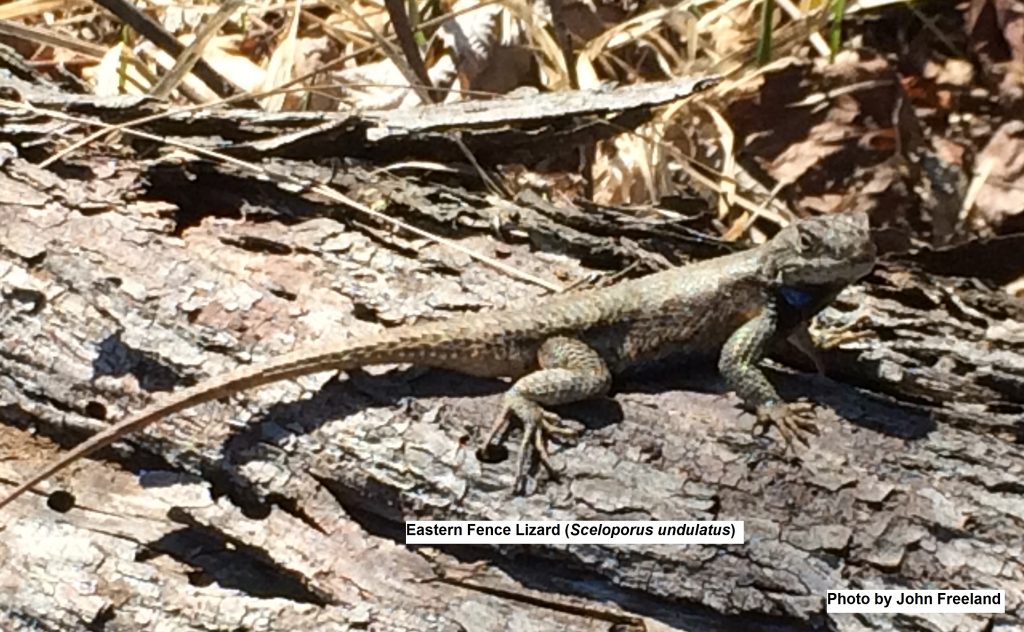
After a slow, plodding climb up a steep hill in West Virginia, the miogeocline side of the Apallachian mountains, I sat down on a log to catch my breath when, soon, this gregarious creature skittered toward me and, seemingly, looked me straight in the eye. This eastern fence lizard (Sceloporus undulatus) was about seven inches long, and out in full sunshine near the edge of a clearing. It was a treat to see it up close as, being something of a “klutz” in the field, I usually make enough noise to scare wildlife away before having a chance to see it.
This lizard, which eats insects and other invertebrates, is common throughout the southeastern United States, living in and near woodlands where it hides under rocks or in stumps and logs (1).
Fence lizards are oviparous (lay and hatch eggs outside of the body) and females deposit eggs in the soil where they hatch after about ten weeks. That ten week period in the soil is the most vulnerable stage of the lizard’s life cycle as there is no adult protection and the eggs are easily foraged by other reptiles, mammals and insects. One of the insect species that is particularly dangerous to the eastern fence lizard is the red imported fire ant (Solenopsis invicta) (RIFA). A group of stinging RIFA can kill an eastern fence lizard in about a minute. They also forage on lizard eggs deposited in the soil (2).
Many a picnic has been spoiled by the stinging and biting RIFA and matters may be getting worse. Fire ants thrive in disturbed habitats, including urban areas, and their range is expanding. Something like one-percent of humans experience anaphylaxis, a life-threatening reaction requiring immediate access to epinephrine, when stung by the venomous fire ants (3). A good video of what a RIFA mound looks like is available here.
References
1. National Wildlife Federation, https://www.nwf.org/Wildlife/Wildlife-Library/Amphibians-Reptiles-and-Fish/Eastern-Fence-Lizard.aspx
2. Darraco et al. 2017, Invasive Ants Influence Native Lizard Populations http://onlinelibrary.wiley.com/doi/10.1002/ecs2.1657/pdf
3. NPR, http://www.npr.org/sections/health-shots/2013/03/04/173424247/best-defense-against-fire-ants-may-be-allergy-shot-offense



 Terra Central
Leave a comment