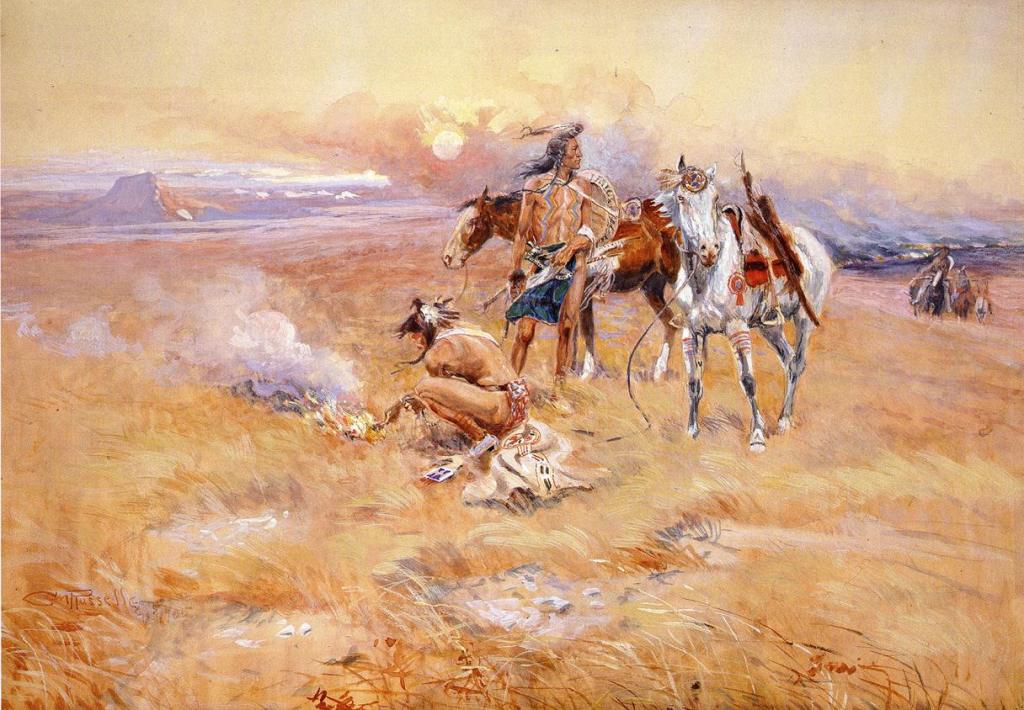
Blackfeet Burning the Buffalo Range, painting by Charles Marion Russell, 1905.
Images of modern prairie burns in the Flint Hills near Council Grove, Kansas have been captured by National Geographic photojournalist Jim Richardson. These fires aimed at maintaining prairie grassland ecology carry on a Native American practice that goes back centuries. The University of Nebraska-Lincoln hosts an online archive of The Journals of the Lewis and Clark Expedition in which George Clark, who probably never won a spelling bee, recorded this remarkable river scene following release of an ice jam near Fort Mandan (present-day North Dakota)
“March 29, 1805
The obstickle broke away above & the ice came dow in great quantites the river rose 13 inches the last 24 hours I observed extrodanary dexterity of the Indians in jumping from one Cake of ice to another, for the purpose of Catching the buffalow as they float down maney of the Cakes of ice which they pass over are not two feet Square. The Plains are on fire in view of the fort on both Sides of the River, it is Said to be common for the Indians to burn the Plains near their villages every Spring for the benifit of ther horse, and to induce the Buffalow to come near to them.”
The fire management plan carried out by the Native Americans was clearly intended to support a “movable feast” as peoples and large game herbivores, especially bison, migrated over the Great Plains in response to conflict, drought, extreme cold and other adverse conditions.
Though most of the area is currently under agricultural use, the unique aspects of what remains of the grasslands of Central North America are threatened by encroachment of less palatable woody plants (trees and shrubs) when fire and herbivory are excluded. Although fire may be highly effective at preventing woody seedling recruitment, it turns out some shrubs and trees have found a “work around” that enable them to spread their branches in the prairie sun.
Positive Feedbacks Promote More Shrub Invasion
In the research paper “Positive feedbacks amplify rates of woody encroachment in mesic tallgrass prairie” (Ratajczak et al. 2011) investigators found that the dominant native shrub rough-leaved dogwood (Cornus drummondii) reproduces by cloning itself, spreading underground rhizomes (roots) into open grasslands. The ability to reproduce vegetatively in this manner helps protect the shrub from fire.
Once established, C. drummondii modifies its environment two ways that help secure its presence and continue its invasion of prairies grasslands: (1) C. drummondii taps deeper soil moisture compared to grasses, thereby out-competing shallower-rooted grasses for water and (2) shading out grasses lessens the fuel load at the shrub-grass interface, lessening the severity of prairie fires. These pro-shrub processes operate best in depressions, stream valleys and swales. Higher topographic positions typically remain too dry for the shrubs.
As a side note, lately I’ve seen more C. drummondii during wetland delineations in Ohio and Michigan. Not sure if it’s because it’s becoming more prevalent or if I’m just noticing it more. It has a wetland wetness rating of “FAC” and it shows up both in and out of wetlands. It’s a tough native shrub that supports a variety of birds and pollinators and a good choice when restoring disturbed sites.
Stable Isotope Fractionation in Grass vs. Shrub Water Use Compartments (What’s Drinking What? )
According to Ratajczak et al., the dogwood shrubs can send roots deeper than prairie grasses, which are known and valued for being deep-rooted and boosting carbon concentration in soils. To support the claim, however, the research team used stable isotope analysis to compare water uptake in grasses vs. shrubs. They found that the dogwood were accessing deeper soil moisture as evidenced by higher oxygen-18 concentrations in water extracted from shrub leaves, compared to grasses.
For more background on the use of stable isotope analysis in ecological and hydrologic studies, including the significance of SMOW and the Pee Dee Belemnite, Carleton University posts A primer on stable isotope analysis and some common uses in hydrology.
Implications for Watershed Hydrology
As these shrubs extend their range into prairie grasslands and utilize deeper soil moisture, to what extent will they alter current patterns of watershed hydrology? It seems reasonable to expect some changes in streamflow, particularly reductions in base flow, which may ultimately affect human water supplies.


Leave a comment